


The Evolution of Wrap-Ups
The Evolution of Wrap-Ups: Laws, Lessons, and the Future of Construction Risk From state-specific requirements...


Lorem Ipsum is simply dummy text of the printing and typesetting industry's standard dummy text ever since the 1500s.
Read Full Case Study

Lorem Ipsum is simply dummy text of the printing and typesetting industry's standard dummy text ever since the 1500s.
Read Full Case Study

Artificial intelligence (AI) is no longer a futuristic concept—it’s actively reshaping industries, including construction.
Tags: AI Innovation, Construction, Insurance
Read More
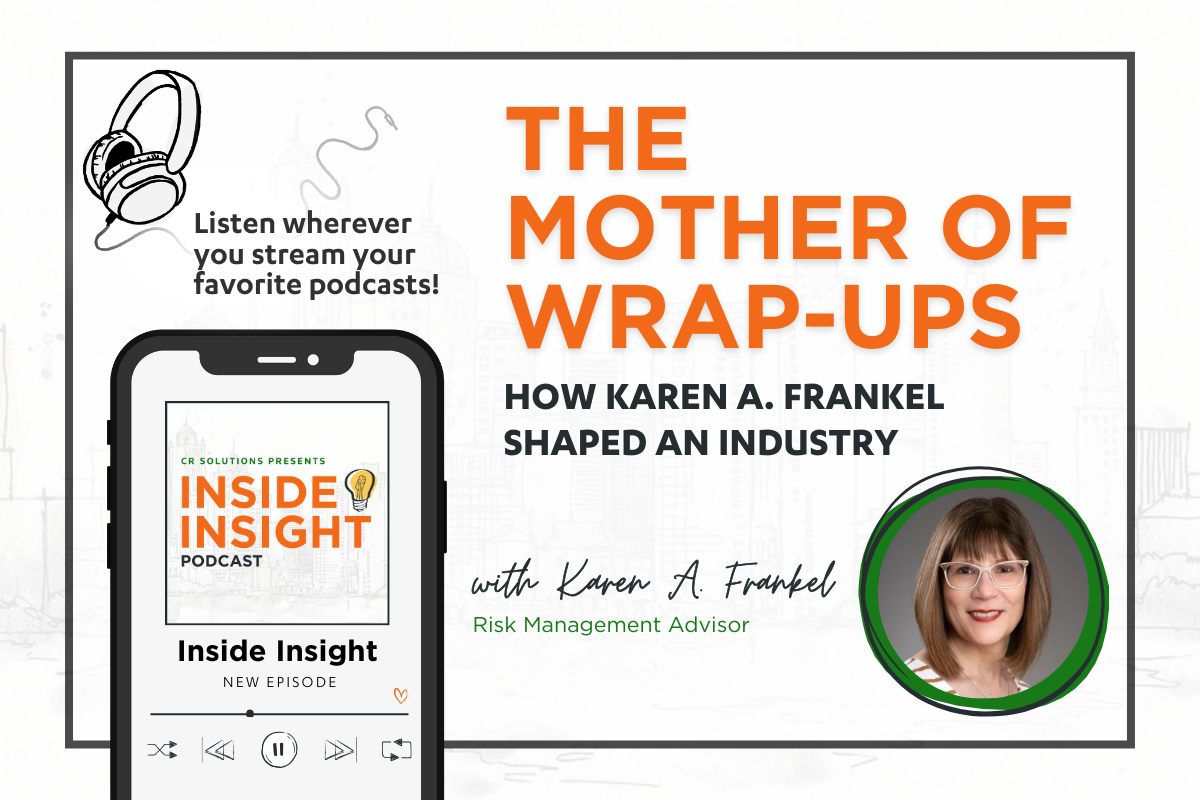
Before wrap-up administration became software, workflows, and standardized reporting, someone had to decide what the process should actually be. Karen A. Frankel was one of the people building that foundation.
Modern wrap-up administration can feel established enough that it is easy to forget how much of it had to be invented.
Enrollment forms, bid alternates, contractor reporting, administrative manuals, project files, audit procedures, and the systems used to organize them all now feel like recognizable parts of construction insurance. But when Karen A. Frankel entered the wrap-up space in the early 1980s, much of that infrastructure either did not exist or had not yet been standardized.
Her career gave her an unusual perspective on the problem.
Frankel started on the construction side as a project accountant before becoming Minnesota's first female estimator and later its first female project manager for a major general contractor. She then moved into insurance and surety, eventually working with some of the largest contractors and project owners in the country.
That combination matters. Frankel did not approach wrap-ups only as an insurance professional. She understood how contractors estimated work, managed budgets, dealt with incomplete information, and lived with the financial consequences of decisions made before construction began.
Her first conversation on the Inside Insight Podcast presented by CR Solutions is therefore more than an industry history lesson. It is a case study in how operational problems become processes, how processes become standards, and why the people designing construction insurance programs need to understand the businesses those programs affect.
Frankel traces the origins of wrap-up insurance to the period following World War II.
Returning soldiers needed work, government entities needed to build, and construction companies needed to focus on delivering projects. According to Frankel, the idea was straightforward: rather than making each contractor separately manage the insurance requirements associated with a project, the insurance could be "wrapped up" around the project itself.
A master workers' compensation policy and general liability policy would cover the project, and contractors could be added to those policies.
The administrative process was minimal by modern standards.
Contractors could call the broker, provide their information, and eventually receive confirmation through the mail that they had been endorsed onto the program. There was no sophisticated enrollment platform, automated reporting system, or centralized contractor portal.
Frankel recalls that when she entered the space in 1983, only a small group of brokers and carriers were actively involved in wrap-ups nationally.
The market was small enough that many of the people involved knew one another personally.
That context helps explain why so much of what followed had to be built as the market grew. Wrap-ups were no longer simply an insurance placement concept. Once more projects, contractors, owners, carriers, and brokers became involved, the industry needed a repeatable way to administer them.
Frankel's entry into wrap-up administration was not accompanied by a polished operating manual.
Instead, she describes walking into a conference room filled with boxes.
Several active projects had continued generating paperwork while her company evaluated whether to remain in the wrap-up business. Incoming mail had been opened, date-stamped, put back into envelopes, packed into boxes, and stored.
When the decision was made to continue the practice, Frankel inherited the backlog.
"There were no instructions. There was no guidance. There was no national team. There was nobody to show me what to do with the paper."
So she began sorting it.
She grouped similar documents together, determined what needed to happen to each type of information, created a filing structure, developed labels and color coding, and wrote down the process as she went.
"I created the process to work the paper."
That sentence captures something larger than administrative organization.
Frankel was turning individual tasks into a system.
Once the process existed, it could be taught. Once it could be taught, it could be repeated across offices. And once it could be repeated, wrap-up administration could begin moving from individual knowledge toward institutional practice.
The broader lesson is easy to recognize in many industries. Standardization often begins long before the technology that eventually automates it.
Software does not create a process simply by existing. Someone first has to understand the work well enough to define what the system should do.
Another problem emerged when early projects began reaching completion.
Owners wanted to know whether the wrap-up had saved money.
Frankel recalls standing before the board of a major utility and being asked that exact question.
Her answer was uncomfortable but important: they did not really know.
The program had not been structured in a way that created a reliable comparison between the cost of the wrap-up and what contractors would otherwise have paid to provide their own insurance.
There was another complication. During the project, the insurance market had tightened significantly. Limits that had once been available became difficult or impossible for contractors to purchase.
That meant the value of the wrap-up could not be measured purely through premium savings. The program had also created access to insurance capacity that individual contractors might not have been able to provide.
But Frankel still wanted a way to quantify the insurance cost that would otherwise have been included in contractor bids.
Her construction estimating background offered the answer.
Estimators were already accustomed to alternate bids. A contractor might price a project one way, then separately price an optional element that could later be accepted or rejected.
Why not do something similar with insurance?
The contractor could identify what its insurance would cost if it had to provide coverage for the project. That amount could then become an alternate used to understand the insurance component of the bid.
Frankel developed worksheets to capture those costs and accommodate different rating approaches, whether a contractor's insurance was driven by contract value, payroll, or another basis.
That work helped establish what became add and deduct alternate methodologies used in wrap-up bidding.
The important idea was not simply subtracting insurance from a contract.
It was creating visibility.
Owners needed a way to evaluate cost. Contractors needed a way to explain how insurance affected their price. And the process had to recognize that different contractors structured their insurance differently.
Frankel's estimating background also shapes one of her strongest criticisms of modern wrap-up practices.
She believes some programs have pushed insurance deductions too far.
One example is overhead and profit.
If insurance is removed from a contractor's bid, it may seem logical to remove the overhead and profit associated with that insurance cost as well. Frankel challenges that assumption because participation in a wrap-up does not eliminate the contractor's administrative burden.
The contractor may still need to enroll, report payroll, provide information for audits, coordinate subcontractors, and manage project-specific administrative requirements.
"You cannot just take their overhead and profit on the line item of insurance."
Her argument exposes a broader tension in wrap-up pricing.
An insurance calculation can look mathematically correct while still being operationally incomplete.
If the methodology ignores how contractors actually perform the work required by the program, it may create savings on paper while shifting administrative costs elsewhere.
That is one reason Frankel repeatedly returns to the value of having people with actual construction experience involved in program design.
Understanding insurance is necessary.
Understanding the contractor is also necessary.
Frankel's career spans an extraordinary transition in administrative technology.
She remembers an era when an entire basement could house mainframe computers dedicated largely to payroll. She remembers key-punch cards, 10-key calculators, early laptops with enormous battery packs, Lotus 1-2-3, DOS programming, and the gradual move from paper files into spreadsheets and purpose-built systems.
As wrap-up administration became more complex, technology made it possible to process more information and distribute systems across national practices.
Frankel was involved in building and refining several of those systems over the course of her career.
But her story suggests that technology was not the innovation by itself.
The innovation began earlier, when people decided what information mattered, how it should be organized, what calculations were necessary, and how each step should connect to the next.
Only then could those decisions be translated into software.
That distinction remains relevant today.
A new platform can accelerate a bad process just as easily as a good one. The quality of the technology still depends on the quality of the logic underneath it.
As wrap-ups gained visibility, more professionals entered the space.
Frankel points to industry conferences, particularly IRMI, as important places where awareness grew. Roundtable discussions expanded into larger educational sessions, and wrap-ups moved from a relatively specialized practice into a much broader part of construction insurance.
Growth brought benefits.
It also created a problem Frankel still sees today.
A professional could learn enough about wrap-ups to begin selling or administering them without necessarily having deep experience in construction, contractor insurance, estimating, or project operations.
Frankel is particularly concerned when that lack of experience affects program structure.
She recounts reviewing a modern wrap-up program that she believed placed inappropriate deductible obligations on contractors, provided insufficient limits, created completed operations concerns, and attempted to preserve additional insured status on contractor policies despite the existence of the wrap-up.
Her criticism is not that every modern program is poorly designed.
It is that technical sophistication can disguise weak fundamentals.
A complex manual, sophisticated spreadsheet, or polished administration platform cannot compensate for a program structure that does not make sense for the contractors participating in it.
Frankel's experience as an estimator and project manager appears throughout the conversation because it changes the questions she asks.
Those are not simply insurance questions.
They are construction questions with insurance consequences.
Frankel contrasts earlier projects, where design documents could be substantially complete before bidding, with today's fast track construction environment. When less of the project is fully designed at bid time, contractors face more uncertainty, change orders become more important, and estimating becomes more difficult.
That complexity affects the assumptions behind insurance pricing too.
The larger implication is that wrap-up administration should not exist in isolation from project delivery.
A construction insurance program ultimately has to function inside a construction project.
That sounds obvious, but Frankel's critique suggests the industry sometimes treats the insurance mechanics as if they can be optimized independently.
They cannot.
Near the end of the conversation, Frankel is asked what has kept her engaged through nearly five decades of construction and insurance.
Her answer is surprisingly simple.
She lives by two mantras:
"Do good every day."
And:
"Learn something new every day."
She then offers another principle that may explain much of her career:
"Where you see a need, you fill it."
That philosophy ties together the story of her work.
The conference room full of boxes needed a system, so she built one.
Owners needed a better way to understand insurance costs, so she developed a methodology.
Administration needed to move beyond paper, so she helped translate those processes into technology.
And when Frankel now sees practices she believes create unnecessary risk for contractors, she still challenges the assumptions underneath them.
The history of wrap-ups is therefore not only a story about insurance products.
It is a story about people recognizing that a process was incomplete and deciding to make it better.
The tools have changed dramatically since Frankel first entered the space. The principle has not.
For today's construction risk professionals, that may be the most useful part of the history to preserve.
Karen A. Frankel, a nationally recognized construction insurance authority and Risk Management Advisor, joins Inside Insight to share the history behind modern wrap-up programs and the processes that helped shape today's administration practices.
Hear Karen discuss her path from construction estimating and project management into insurance, the early days of wrap-ups, the development of add and deduct alternate bidding, the transition from paper administration to technology, and the lessons she believes the industry should not forget.
Continue the conversation with The Evolution of Wrap-Ups: Laws, Lessons, and the Future of Construction Risk, where Karen explores state-specific requirements, modern administration, contractor education, fast track construction, and the role technology may play in the future of construction risk.


The Evolution of Wrap-Ups: Laws, Lessons, and the Future of Construction Risk From state-specific requirements...
Listen to the full episode here! PODCAST OPENER Welcome to the Inside Insight podcast...

Listen to the full episode here! PODCAST OPENER Welcome to the Inside Insight podcast...

Listen to the full episode here! PODCAST OPENER Welcome to the...
Brave New Code: Inside the technology turning insurance data into actionable underwriting intelligence Artificial intelligence...

Listen to the full episode here! PODCAST OPENER Welcome to the...
The Algorithm of Advantage: How agentic AI is helping insurers turn complex portfolio data...

The Future Is Flowing: How Insight Risk Is Reinventing Builders Risk Water damage is...

Listen to the full episode here! PODCAST OPENER Welcome to the Inside Insight podcast...

The New Rules of Risk: Rocio Luna on Evolving Risk Management Season 3 of...

Listen to the full episode here! PODCAST OPENER Welcome to the Inside Insight podcast...

Listen to the full episode here! PODCAST OPENER Welcome to the Inside Insight podcast...
